



Why Does E Bike Tire Pressure Matter More Than Regular Bikes?
1. Heavy Overall Weight Load
E-bikes carry extra weight due to their hub or mid-drive motors, high-capacity lithium batteries, and reinforced alloy frames. A typical commuter e-bike weighs between 20 kg to 30 kg (45 to 65 lbs)—significantly heavier than a traditional road or city bike. This increased baseline weight puts extra structural load on your tires. Proper inflation provides the structural air cushion needed to support both the bike and the rider without bottoming out over bumps.
2. The Ultimate Battery Range Killer
Rolling resistance directly impacts how hard your motor must work. When your tire pressure is too low, the rubber deforms, creating a larger contact patch with the road. This friction forces the electric motor to draw more battery power to maintain speed, causing your riding range to drop significantly. Keeping optimal e bike tire pressure ensures your battery delivers maximum mileage per charge.
3. High-Speed Stability and Safety
Electric bikes comfortably cruise at speeds of 20 to 25 km/h (15 to 20 mph) or higher. At elevated speeds, cornering traction, braking distance, and control become paramount. Correct tire pressure maintains the ideal tread shape against the asphalt, offering predictable grip when cornering sharply or making sudden stops.
Factors That Determine Your Perfect E-Bike PSI
1. Tire Type & Width
- City & Commuter Tires (Narrow / Standard, 1.5"–2.0"): These tires typically require higher pressure—usually between 50 and 70 PSI—to minimize rolling resistance on smooth tarmac and maximize efficiency.
-
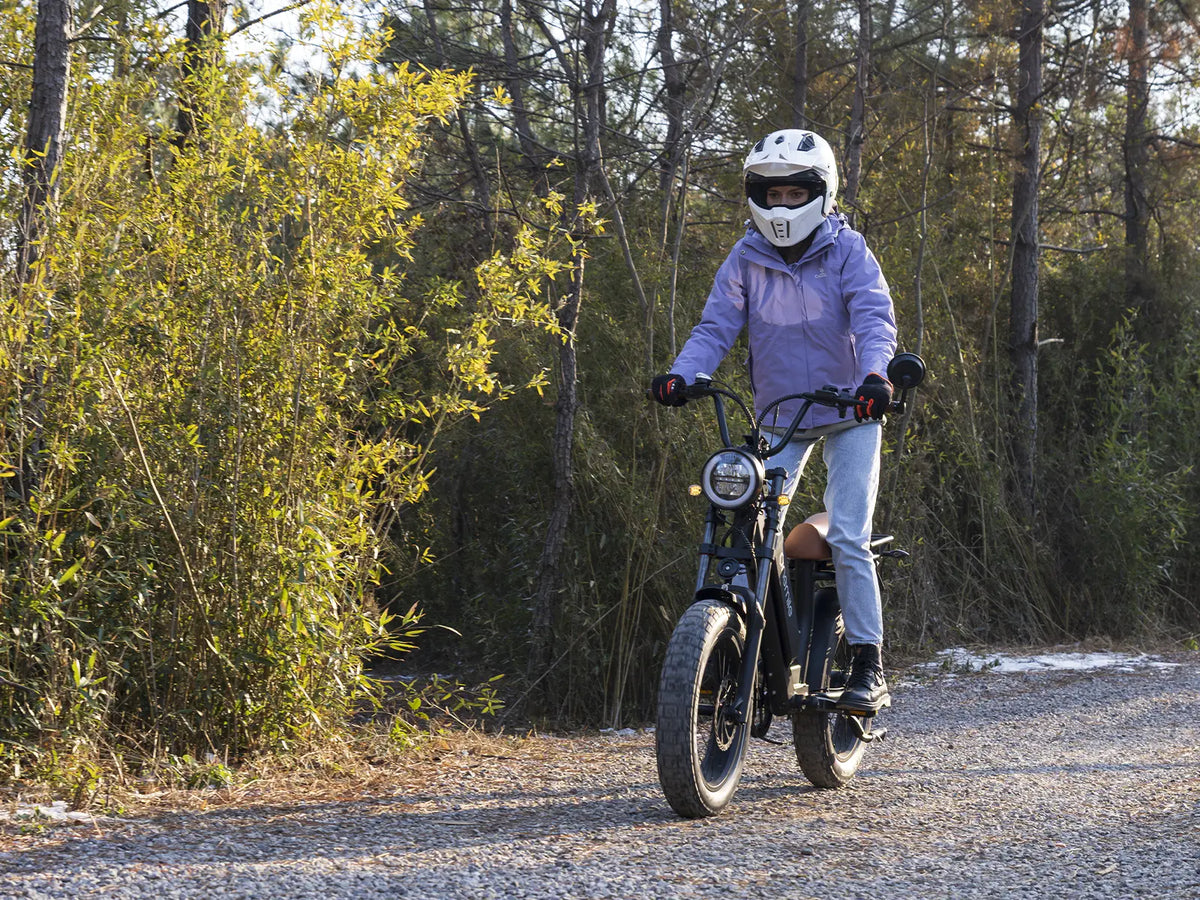
Fat Tires (3.0"–4.0"+): Popular on all-terrain e-bikes, fat tires rely on lower pressures—typically 20 to 30 PSI (or even lower on soft sand/snow)—to absorb road chatter, act as natural suspension, and maximize traction.
2. Rider & Cargo Weight
The total weight on the e-bike plays a major role in determining PSI. Heavier riders or commuters carrying panniers, groceries, or child seats need higher inflation to avoid excessive tire sagging.
Rule of Thumb: Increase your tire pressure by 1 to 2 PSI for every additional 10 kg (22 lbs) of payload, ensuring you never exceed the maximum PSI printed on the tire sidewall.
3. Riding Terrain
- Smooth Asphalt & City Streets: Inflate toward the higher end of your tire's recommended PSI range for lower friction, faster speeds, and improved power efficiency.
- Wet, Gravel, or Rough Surfaces: Lower your pressure slightly (by 3–5 PSI). A softer tire molds over bumps and pebbles, expanding the contact patch to deliver superior traction and a cushioned ride.
4. Weather & Temperature
- Winter Cold: Air contracts in freezing temperatures, causing tire pressure to drop (roughly 1–2 PSI for every 10°C / 20°F drop). Regular top-ups are essential during cold months.
- Summer Heat: Sun exposure and high tarmac temperatures cause air to expand. Avoid over-inflating tires in extreme heat to prevent over-pressurization.
The Danger Zones: Too High vs. Too Low
|
Aspect |
Under-Inflated Tires (Too Low) |
Over-Inflated Tires (Too High) |
|
Puncture Risk |
High risk of "pinch flats" (snake bites) where the rim crushes the inner tube over bumps. |
Higher risk of sudden blowouts under impact or heat expansion. |
|
Ride Comfort |
Soft and sluggish; increased risk of rim damage on hard impacts. |
Extremely harsh, bumpy, and rigid ride quality. |
|
Range & Speed |
Rapid battery depletion due to high rolling resistance; slower acceleration. |
Excellent rolling efficiency on smooth roads, but loses speed on bumpy roads. |
|
Tire Wear |
Excessive, uneven wear along the outer tire shoulders. |
Accelerated wear along the center line of the tread pattern. |
|
Grip & Handling |
Heavy, responsive-lacking steering; slipping in tight corners. |
Reduced contact patch leading to poor traction on wet or slick surfaces. |
How to Check and Maintain Your Pressure in Bicycle Tyre
- Check the Tire Sidewall: Before inflating, always inspect the side of your tire. Manufacturers stamp a recommended range (e.g., "MIN 40 - MAX 65 PSI"). Stay strictly within these boundaries.
- Use a Pressure Gauge or Digital Pump: E-bike sidewalls are naturally stiffer, making low tires feel deceptively firm. Use a track pump with an integrated pressure gauge or a portable digital pressure checker.
- Set a Regular Checking Schedule: E-bikes naturally lose air over time faster than traditional bicycles due to higher pressures and heavy motor torque. Check your pressure in bicycle tyre setups once a week or every two weeks to keep performance consistent.
Conclusion
By matching your PSI to your tire type, weight load, and terrain, you instantly gain smoother comfort, superior cornering grip, and extra kilometers on every charge.
Check your tire sidewall today, grab a reliable pressure gauge, and experience the full potential of your Onemile ebike!

Hinterlasse einen Kommentar
Alle Kommentare werden vor der Veröffentlichung geprüft.
Diese Website ist durch hCaptcha geschützt und es gelten die allgemeinen Geschäftsbedingungen und Datenschutzbestimmungen von hCaptcha.